Most Audits Identify Issues. A Visibility Audit Explains Them.
Updated: 7 days ago
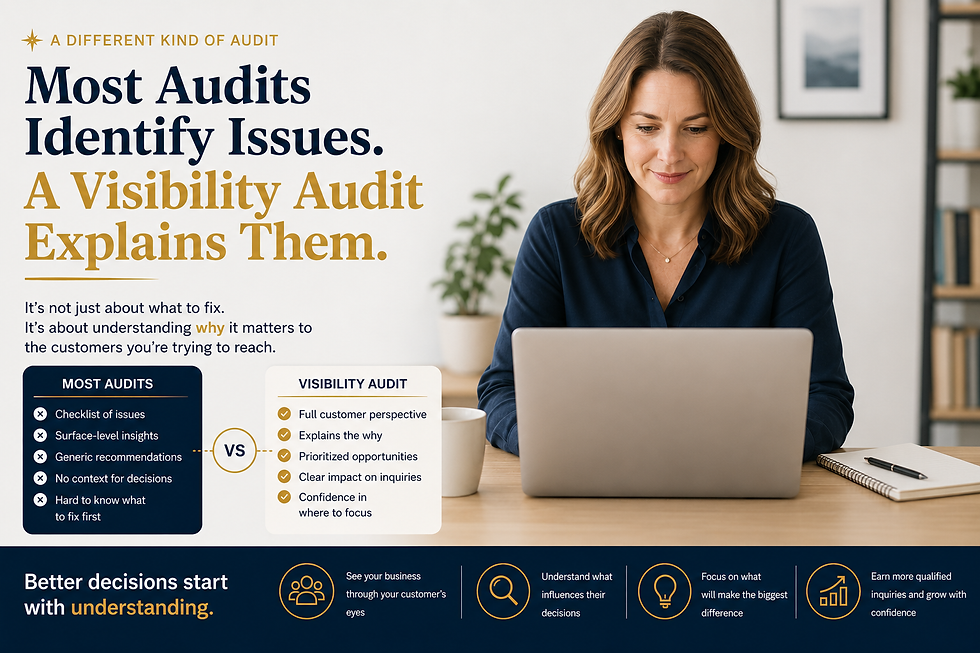
When business owners decide it's time to improve how they're found online, they're often given a list of recommendations. Update your website. Improve your search rankings. Collect more reviews. Add more keywords. Post more often.
Many of these recommendations may be worthwhile. The challenge is that they don't always answer the most important question:
Why are prospective customers choosing another business?
That's where a Visibility Audit takes a different approach.
Rather than simply identifying issues, a Visibility Audit explains how prospective customers experience your business, why competitors may have an advantage, and which improvements are most likely to make a meaningful difference. Understanding the "why" behind the findings allows you to make informed decisions instead of relying on assumptions.
Knowing What to Change Isn't the Same as Knowing Why
Imagine your website receives visitors, but very few people contact you. Is the problem your website, your Google Business Profile, your reviews, your messaging—or something else entirely?
Without understanding the reason behind the problem, it's easy to spend time and money improving the wrong thing. Business owners often assume they need a new website, more advertising, or better search rankings, when the real issue may be something entirely different.
A Visibility Audit begins by evaluating how prospective customers actually experience your business before recommending what should change. Instead of jumping directly to solutions, it identifies the factors that may be influencing customer decisions so you can focus on the improvements that matter most.
Customers Don't Experience Your Business One Piece at a Time
Business owners naturally think about their marketing in separate pieces. They have a website, a Google Business Profile, online reviews, search rankings, business listings, and social media accounts.
Prospective customers don't separate those elements. They experience them together.
A customer may first notice your Google Business Profile, compare your reviews with nearby competitors, visit your website, and decide within minutes whether your business feels like the right choice. The overall experience matters more than any single marketing element.
That's why a Visibility Audit evaluates your business the way prospective customers experience it—not the way a marketing checklist organizes it.
Every Recommendation Should Have a Reason
If someone recommends updating your website, collecting more reviews, or changing your messaging, it's reasonable to ask one simple question:
Why? Every recommendation should have a purpose.
A Visibility Audit connects each recommendation to the customer experience. Rather than simply identifying areas for improvement, it explains how those opportunities may be influencing a prospective customer's decision. That context helps you prioritize your time and resources where they're most likely to strengthen visibility, credibility, and qualified inquiries.
Looking Beyond the Checklist
A checklist can tell you whether something exists.
It can't always tell you whether it's working.
For example:
Is it immediately clear what your business does?
Do prospective customers understand why they should choose you?
Does your business appear trustworthy compared with nearby competitors?
Is contacting you simple and obvious?
Those questions can't always be answered by checking a box. They require looking at your business through the eyes of someone seeing it for the first time. That's exactly what a Visibility Audit is designed to do.
What Does a Visibility Audit Show?
A Visibility Audit evaluates how prospective customers experience your business before they decide whether to contact you. It compares your business with nearby competitors and identifies opportunities to improve:
Search visibility
First impressions
Customer trust
Website clarity
Contact experience
Overall customer confidence
Instead of receiving a generic list of recommendations, you'll understand why each opportunity matters and how it may influence customer decisions. That makes it easier to prioritize improvements that can have the greatest impact on your business.
The Goal Is Clarity
Most business owners already know there are opportunities to improve. The difficult part is understanding which opportunities matter most.
A Visibility Audit provides an objective view of how your business appears online, compares your customer experience with nearby competitors, and prioritizes the improvements most likely to strengthen visibility, credibility, and qualified inquiries.
Instead of guessing where to focus next, you'll have a clearer understanding of what prospective customers see—and why it matters.
Final Thoughts
Most audits identify issues. A Visibility Audit explains them. That difference matters because better decisions begin with a better understanding of the problem. When you understand how prospective customers experience your business—and where competitors may have an advantage—you can make improvements with greater confidence and purpose.
The goal isn't simply to create another list of recommendations. It's to help you understand why prospective customers may be choosing another business, so you can make thoughtful improvements based on evidence instead of assumptions.
Understand the "Why" Behind Your Customer Experience
A Visibility Audit compares how your business appears to prospective customers, explains where competitors may have an advantage, and prioritizes practical improvements that can help you earn more qualified inquiries.


Comments